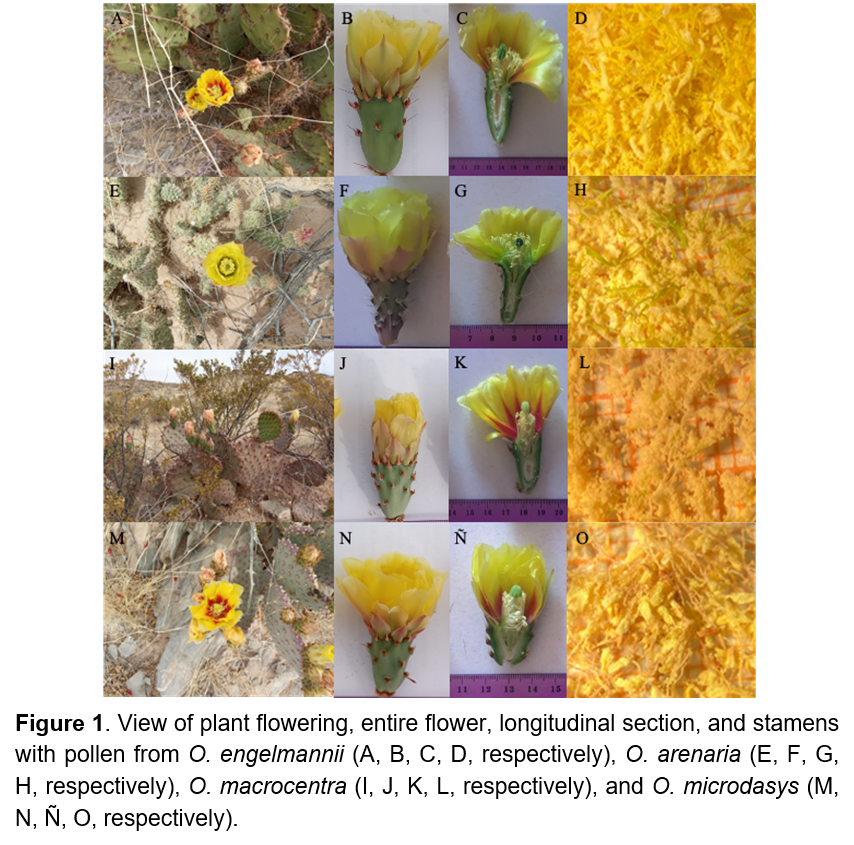
Chemical composition and antioxidant activity of stamens in four species of the genus Opuntia
DOI:
https://doi.org/10.56890/jpacd.v28i.607Keywords:
Cacti, plant pigments, natural antioxidants, flavonoids, phenols, principal components analysisAbstract
Currently, information on the phytochemical composition and functional activity of Opuntia genus stamens remains limited, but recent studies have shown promising results. Further research on this topic is necessary to apply it to the differentiation between species and evaluate their chemical richness and antioxidant potential. In this context, the present study analyzed the chemical profile and antioxidant activity of the stamens of four Opuntia species. Aqueous extraction with methanol was performed, and various phytochemicals, including pigments, phenolic compounds, flavonoids, condensed tannins, and reducing sugars, were quantified using spectrophotometric methods. Antioxidant activity was also assessed using FRAP and DPPH assays. Principal components analysis explained 97.9% of the total variation. Reducing sugars strongly correlated with component 1 (0.99), while chlorophyll b (0.67), the antioxidant activity as determined by FRAP (0.45), and carotenoids (0.38) were associated with component 2. The stamens of O. microdasys exhibited the highest levels of reducing sugars and carotenoids, while O. macrocentra and O. arenaria showed the lowest values, respectively. The highest antioxidant capacity (FRAP) was observed in O. arenaria and O. microdasys, and the lowest in O. engelmannii. Overall, the results suggest that the stamens of O. microdasys constitute a promising source of bioactive compounds, with potential for applications in pharmacology and nutrition.
Publication Facts
Reviewer profiles N/A
Author statements
Indexed in
- Editor & editorial board
- profiles
- Academic society
- Journal of the Professional Association for Cactus Development
- Publisher
- Professional Association for Cactus Development

To learn about these publication facts, click 
PF is maintained by the Public Knowledge Project