Germination of Peniocereus greggii (Engelm.) Britton & Rose is regulated by seed age and temperature, not scarification
DOI:
https://doi.org/10.56890/jpacd.v28i.618Keywords:
physiological dormancy, after-ripening, conservation, desert plants, seed propagationAbstract
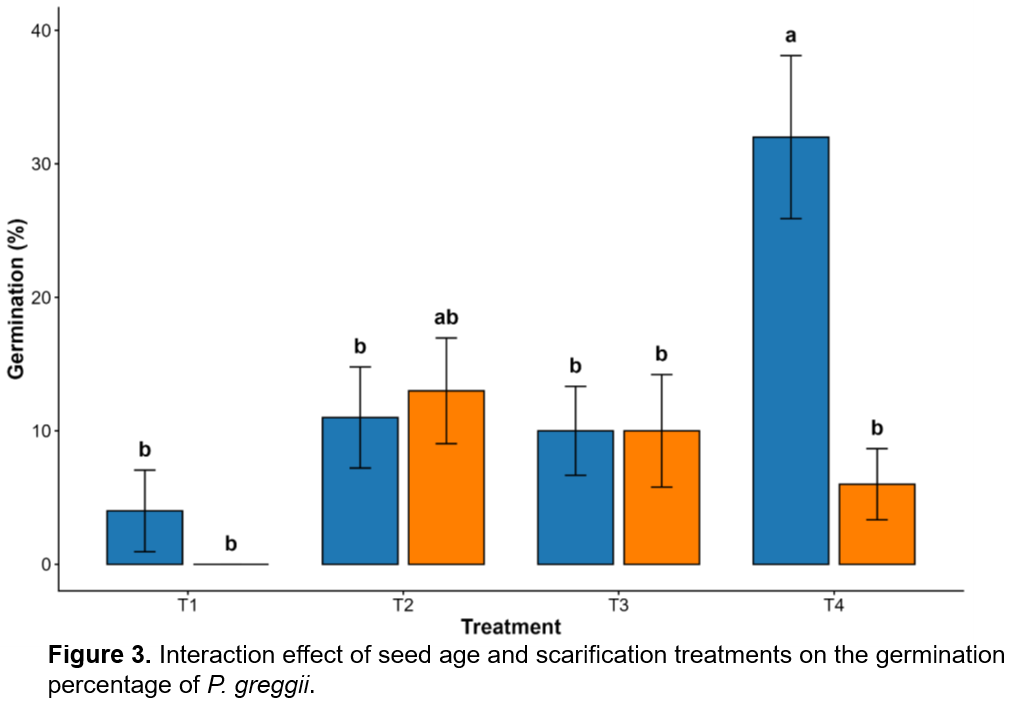
Peniocereus greggii (Engelm.) Britton & Rose is a species listed as Subject to Special Protection (Pr) under Mexican standards, with significant ecological value in the Chihuahuan Desert, yet information regarding its propagation remains scarce. This study evaluated the effects of seed age (fresh vs. 7-year storage), temperature (constant 24 °C vs. fluctuating 30–37 °C), and scarification treatments (H?SO? at 40% and 50%, mechanical incision, and control) on germination. A three-way ANOVA revealed significant differences for all factors and a significant interaction between seed age and scarification. Scarification alone did not improve germination; acid treatment (H?SO?) effectively inhibited germination, while mechanical incision underperformed the control. Germination was significantly higher in aged 2016 seeds than in 2022 seeds, and was strictly higher under a moderate, constant temperature (24 °C) than under fluctuating high temperatures. These results provide solid inferential evidence that P. greggii seeds possess physiological dormancy that is naturally alleviated by after-ripening. Consequently, artificial scarification is unnecessary and detrimental. For ex situ conservation, we recommend extended dry storage of seeds, followed by sowing under moderate temperature conditions (24 °C), and strictly avoiding physical or chemical modifications to the seed coat.
Publication Facts
Reviewer profiles N/A
Author statements
Indexed in
- Editor & editorial board
- profiles
- Academic society
- Journal of the Professional Association for Cactus Development
- Publisher
- Professional Association for Cactus Development

To learn about these publication facts, click 
PF is maintained by the Public Knowledge Project