Agro-climatic suitability of Opuntia ficus-indica under future climate scenarios (SSP2 and SSP5) in north-central Mexico
DOI:
https://doi.org/10.56890/jpacd.v27i.601Keywords:
agro-ecological zoning, climate change, food production systemsAbstract
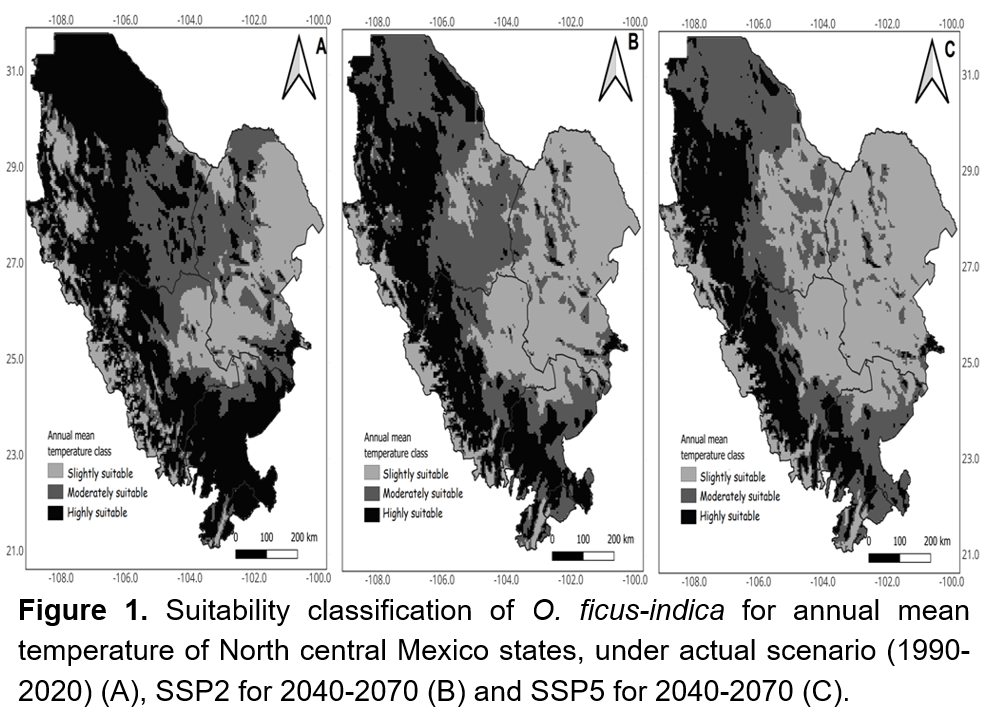
The impact of climate change on food production systems affects agri-food safety and, consequently, national food sovereignty. Thus, food systems must adopt new practices, including the modification of crop selection. Within this context, agro-climatic suitability studies for species adapted to warmer temperatures and drought are crucial. Opuntia ficus-indica is a tolerant crop, notable for its nutritional and cultural significance. For that reason, the objective of this study was to determine its agro-climatic suitability using annual precipitation, mean temperature, and minimum temperature for the current scenario (1990-2020) and the 2040–2070 period, defined by the Shared Socioeconomic Pathways (SSP) 2 and 5. The results showed a general decrease in the proportion of highly suitable territory, with the notable exception of Zacatecas. This state, known as a major national producer of this crop, exhibited a 17% increase in the proportion of suitable territory in the 2040-2070 scenarios for both SSPs compared to the current scenario. The model's validity was confirmed via Chi-square (?2) and Frequency Ratio (FR) analysis for current scenario. Overall, this research indicates a reduction in optimal agro-climatic conditions for O. ficus-indica cultivation in the north-central states of Mexico.
Publication Facts
Reviewer profiles N/A
Author statements
Indexed in
- Editor & editorial board
- profiles
- Academic society
- Journal of the Professional Association for Cactus Development
- Publisher
- Professional Association for Cactus Development

To learn about these publication facts, click 
PF is maintained by the Public Knowledge Project